Why Every Builder Needs a Client Portal in 2026
Your clients are booking Ubers, tracking DoorDash drivers, and managing their entire financial lives from their phones. Then they hire you and get... a text thread? A voicemail at 7 AM? A shoebox of paper change orders? It is 2026. Builders who offer a client portal are winning jobs before the first nail is driven — because the experience itself is part of the product.
What a Client Portal Replaces
Most builders communicate with clients through a patchwork of channels that were never designed for project management:
| Old Way | The Problem | Client Portal Solution |
|---|---|---|
| Phone calls | Interrupts your workday, nothing in writing | Async messaging with full history |
| Text messages | Lost in scroll, no file attachments, no structure | Organized by project, room, or topic |
| Email chains | Buried, forwarded, lost attachments | One shared timeline everyone can see |
| Paper change orders | Lost, unsigned, disputed later | Digital change orders with e-signatures |
| In-person selection meetings | Scheduling nightmares, forgotten decisions | Online finish selection boards |
| Mailed invoices | Slow payment, check-in-the-mail excuses | Online payment with Stripe |
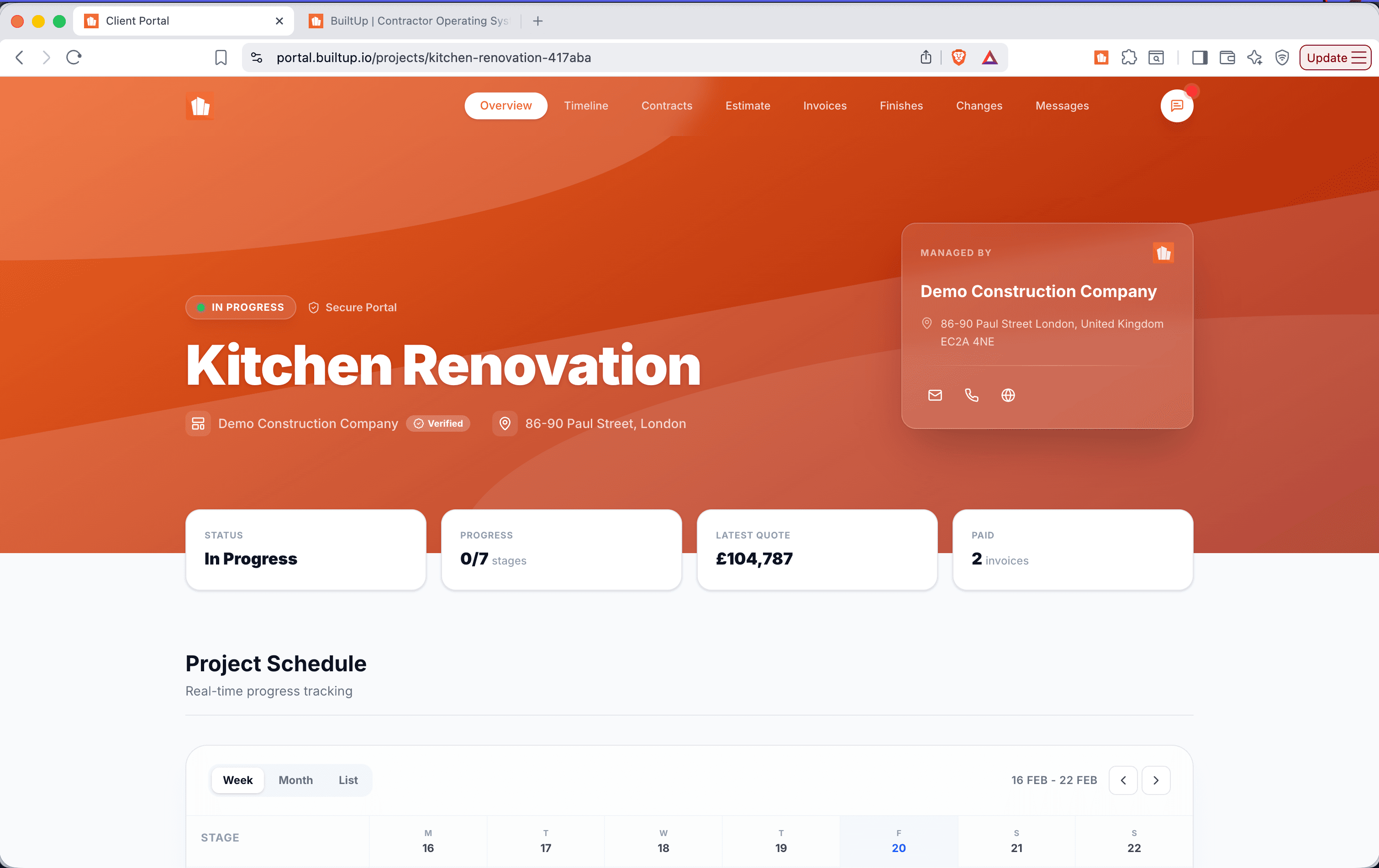
A client portal does not add complexity. It removes it — by giving both you and the homeowner a single place to see everything: schedule, budget, selections, documents, photos, and messages.
Features That Actually Matter
Real-Time Project Timeline
Clients can see what phase the project is in, what is coming next, and whether anything is behind schedule. This eliminates the single most common client question: "So... how's it going?" According to the NAHB, communication-related disputes are the leading cause of negative contractor reviews. A visible timeline solves most of them.
Finish Selections
Tile, hardware, paint colors, countertop material, fixtures — the selection process is where projects stall. A portal lets clients browse options, compare, and make selections on their own time. When they choose, the decision is documented, timestamped, and locked in. No more "I thought we said brushed nickel, not polished chrome" arguments.
Photo Updates
Your crew or site super snaps daily photos and they appear in the portal instantly. Clients feel involved without being on-site. This single feature reduces site visits by homeowners (which slow down your crew) by up to 60%.
Document Sharing
Contracts, plans, permits, warranties, inspection reports — everything lives in one searchable place. When the client sells the house in five years and the new owner asks for the warranty on the HVAC, they can find it themselves.
E-Signatures
Change orders, selection approvals, contract amendments — all signed digitally. No printing, scanning, or chasing wet signatures. Turnaround goes from days to minutes.
Online Payments
This is the feature that pays for itself. When you send a progress draw through the portal with a "Pay Now" button linked to Stripe, clients pay in hours, not weeks. BuiltUp users report average payment times dropping from 21 days to 3 days after enabling portal payments.
How a Client Portal Reduces Callbacks by 80%
The math is straightforward. Most "callbacks" — phone calls, texts, and emails from clients — fall into predictable categories:
- "What's the schedule?" — answered by the timeline view.
- "Did you get my selection?" — answered by the selection board with confirmation.
- "Can I see what it looks like now?" — answered by daily photo updates.
- "Where's the invoice?" — answered by the financial tab.
- "Did you get my check?" — eliminated by online payment.
When the AGC surveyed contractors using client-facing technology, 78% reported "significant reduction" in inbound client communication — freeing up an average of 5–8 hours per week for the project manager or business owner.
"My phone used to ring 15 times a day from clients. Now it's maybe twice. Everything they need is in the portal. I get my afternoons back."
What Clients Say About Portals
Here is the part that surprises most builders: clients do not just tolerate portals — they love them. In a 2025 homeowner survey by the NAHB, 83% of respondents said access to an online project portal would "strongly influence" their choice of contractor. It is not a nice-to-have. It is becoming a competitive requirement.
Clients perceive builders with portals as more professional, more organized, and more trustworthy. That perception directly converts to referrals. One BuiltUp builder reported a 40% increase in referral business within six months of launching their branded client portal.
Frequently Asked Questions
Do my clients need to download an app?
The best portals are web-based — clients click a link and log in from any browser. No app download required. BuiltUp's client portal works on desktop, tablet, and mobile out of the box.
What if my clients are not tech-savvy?
If they can use Facebook or Amazon, they can use a client portal. The interface should be simple: big buttons, clear labels, minimal clicks. Older clients often appreciate portals more because they can check progress at their own pace without feeling like they are bothering you.
How much does a client portal cost?
Standalone portal tools range from $50–$200/month. Integrated platforms like BuiltUp include the client portal as part of the project management suite, so there is no extra cost. Compare that to the value of one fewer dispute per year, and it pays for itself many times over.
Can I brand the portal with my company logo?
Most quality platforms offer white-labeling or at least logo customization. Your clients should feel like they are logging into your system, not a generic software tool. It reinforces your brand every time they check the project.
The Bottom Line
A client portal is not a luxury — it is infrastructure. It protects your time, reduces disputes, accelerates payments, and makes you look like the professional you are. The builders who adopt portals today are setting the standard that every homeowner will expect tomorrow. The question is whether you want to lead that standard or chase it.